Showing posts with label games. Show all posts

Tuesday, October 5, 2010

The Cruel Optimism of Civilization

Let's see how badly I can mangle Lauren Berlant's concept (and future book title) of cruel optimism.

I have a lot of unfinished Civilization games.  Most of the games I start, actually, I never finish.  Often I rationalize this as the tendency of the game to become "boring" when it becomes too easy, when there is no question of victory, only the future tedium of getting there.  But I also stop playing when it becomes obvious that I cannot win.  I don't think, then, that it's victory or excitement that I'm looking for, but room for optimism.  I play the game to work toward some end, sometimes defined, sometimes not, that I will not want to actually materialize when it does.  At the beginning of a game so much is possible.

One thing that I convince myself bothers me about playing Civilization is the pacing of technologies.  Even at Civilization IV's "Marathon" pace, I feel that eras go by far too quickly.  Very suddenly it becomes the medieval era and all I've had time to do is build a few cities and explore half the map.  I want it all to slow down, to have hundreds of turns before anyone can even build swordsman.  I want to get lost in the minutiae of the ancient era before my workers can do much of anything.  I want to understand, somehow, what each technology does, how it affects gameplay, and what it makes possible.  But if any of that were possible I am sure I really would become bored.  Rather than subjected to time going by too fast, if my fleeting attachment were held in a near stand-still, it surely would fade even more easily.

There is another level of optimism, and another level of my wishes regarding time: as much as I tell myself otherwise, I believe that playing Civilization will somehow give rise to some accomplishment outside of the game, and I believe it will temporarily remove me from the stream of time's passage.  The problem with the latter is embedded in its semantics: one cannot "temporarily" stop time, as there would be no time to count how long time stops.  Eventually it becomes apparent that while I play the game time is "lost" in a way opposite to what I had hoped: the hours of playing really did pass outside the game.

If these optimisms were cruel, however, would I stop playing?  Not exactly.  Attachments are not continuous, no matter how much I tell myself they are.  Periodic dissatisfaction that keeps me coming back for more is how I imagine cruel optimism plays out--in waves.  Yet I will go back, even with a cynical attitude, to the escape that is not an escape, wanting to hover around the possibility of victory.  Or maybe not even victory.

Wednesday, September 15, 2010

Widelands

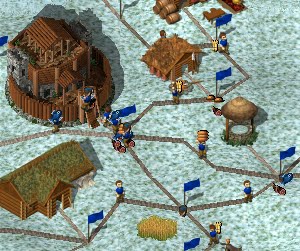
On a long, tensely silent drive with my father and brother on a minor highway, my mind wanders and it occurs to me that Settlers II is giving rise for me to a peculiar view of capitalism.  The game's annoying road system, in which production facilities must be connected meticulously by road to the headquarters of your empire, illustrates the idea that power (to accumulate wealth) resides not in any single mean of production, but in the medium through which products travel.  In Settlers II, your empire consists in the interconnectivity of the spaces in between nodes of harvesting, production, and storage; its might is the bandwidth of its network of roads.  Settlers III does away with this reification of movement: without roads your serfs merely walk freely along the shortest paths between buildings.  It seems a shame to rid the game of the nitpicking of road-building and its visualization of the mechanism of the economy.

Significantly, Widelands is not an open-source mimic of Settlers III, but of Settlers and Settlers II.  I have never played Settlers or Settlers II, or any other game in the Settlers franchise for that matter--only Widelands.  But playing Widelands is a sort of retrospective discovery for me, as certain of my friends in middle school were, I remember now, enthusiastically obsessed with Settlers, like it was a kind of arcane calling.  I guess I can see why.

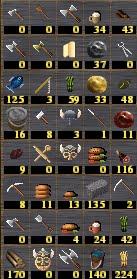
Their cultish adherence to that game had something to do, I imagine, with its absurdly steep learning curve.  Your economy depends upon some forty "wares," each with its own tiny icon, specific purpose, and way to produce.  To this end there are as many buildings, the most effective quantity, placement, and order of which is sure to elude mastery for some time.  After experimenting for a week the computer opponent still effortlessly squashes me, but I might maybe sort of understand how the game works.

The mastery of Widelands, like many other real-time strategy games, illuminates the nature of agency with an eerily hopeless light.  Here the Symbolic swallows the Imaginary whole.  What you learn as you progress toward mastery, toward exerting your will in the game is an increasing certainty of what must be done in order to win.  When you have learned the game, your moves in the game amount to a carrying out of an instruction list.  Once you know how to realize your will to win, playing the game is not to "play" at all, but rather to be an interchangeable executor of commands.  You become a computer processor and your subjectivity is only excess to the game.  Now able to exert your will, you have no will in the sense that you have the one and only will possible, and the means to achieve it are completely determined.

Your workers, too, are reduced to pure function.  They are pure active principles, merely extensions of your direction.  You cannot displease them and they have no needs other than food, although oddly, they sometimes don't act how you expect them to.  They do not riot or resist but the algorithms of the game sometimes cause them to clog your roads with unnecessary wares.  There are four kinds of workers: those that carry wares, those that work to harvest resources or construct buildings, those that fight, and those that mark the locations of resources.  Those that carry wares wait eternally along the roads, walking from point A to point B when necessary, apparently never sleeping.  None of them have any residences, there are only places to work and places in which they are stored until needed, like the wares they toil to produce.

In such a bare conception of civilization, it is perhaps no surprise that there is no trade in Widelands, or any other kind of interaction with other "tribes" besides war.  You may glimpse the other across the pickets of your territory, its workers walking around like ants just as yours do, but this is it: you and the other can only watch your soldiers face off two by two, politely swinging their weapons until one's health bar is reduced to nil and therefore dies.  This is no Civilzation (an oddly less complicated game), there will be no diplomacy, no currying of favor, no treaties, no trade, and certainly no diplomatic victory.  You create to destroy or to be destroyed.

But I keep coming back to try again, foolishly believing there is something to experience between beginning and end.  There is somehow possibility to bask in here: as trees shimmer in the wind and pastoral sound effects report, I watch my workers move wares serenely across my roads and I imagine we're on our way to something better.

(It's true, this post is inspired by and often badly tries to mimic The Nintendo Project.)